Here is a detail that can hold up the sale of a small carrier: the email address on the company's FMCSA Motus account. Sometimes it isn't the company's own address. It may be an address used by a dispatcher or a filing service.
Fixing it can become a closing condition. Before closing, the seller signs in to the company's Motus account, changes that email address, and gives the buyer a screenshot of the change.
It's a small detail, and it shows what selling a trucking company really involves. You aren't handing over a number. You're handing over a company, with its records, filings, accounts and obligations, and the buyer will check each one.
You can't sell the number. You can sell the company.
If you searched "can I sell my MC number," the honest answer is no. In March 2026, FMCSA warned the industry not to sell, buy or lease a USDOT number or operating authority "outside of a legitimate corporate transaction."
The same bulletin shows the legitimate route. If your carrier is an LLC or a corporation, you can sell the company, and in FMCSA's words "the USDOT Number goes with the company." The new owners update FMCSA records "immediately."
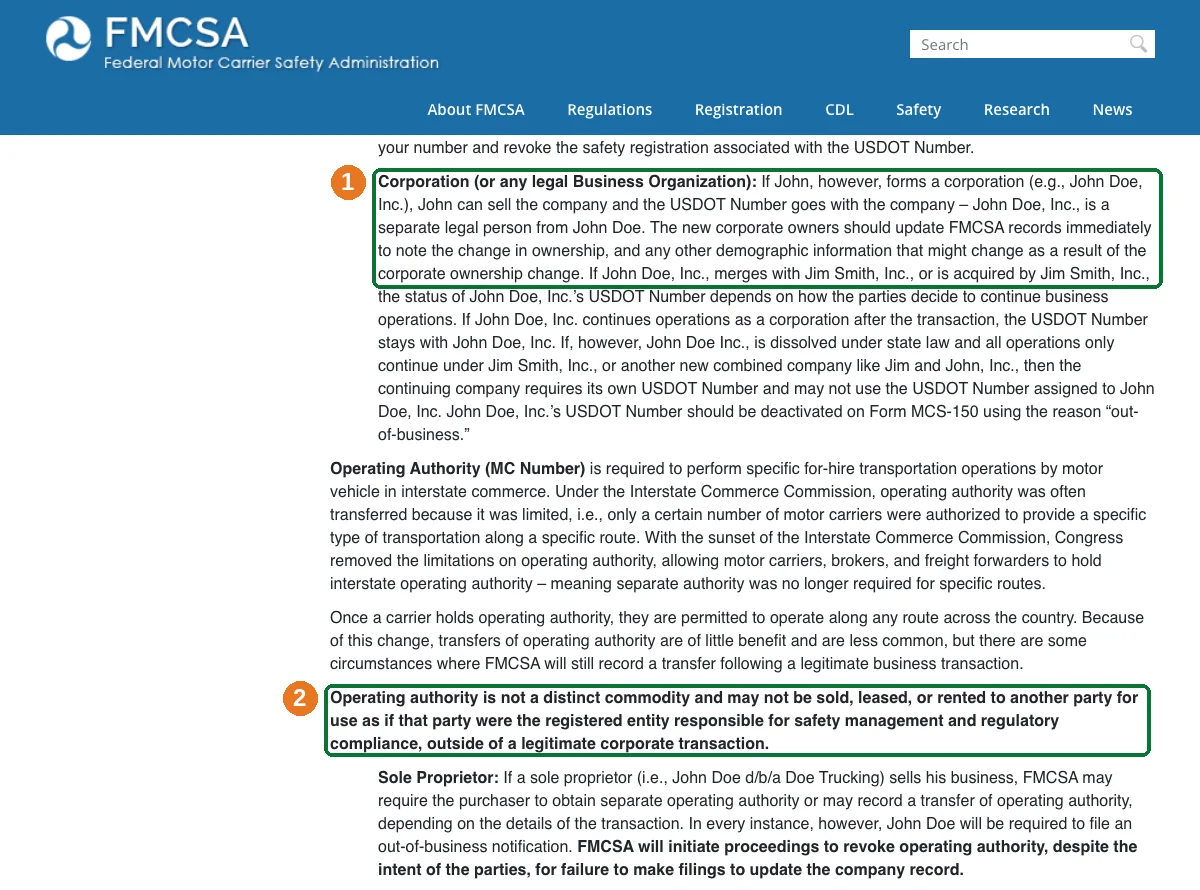
So it comes down to how your business is set up. A sole proprietor's USDOT number can't pass to a buyer; the buyer needs their own number, and the seller files an out-of-business notice. An LLC or corporation can change owners and keep its USDOT and MC. The legal background and the scams behind "MC for sale" ads are in Can you buy an MC number? For a seller the lesson is shorter: get the company ready.
What you're actually selling
In most small-carrier deals the buyer purchases the ownership of your entity: the membership interest of an LLC, or the shares of a corporation. The company stays the same legal entity, with its USDOT number, authority and history. Don't assume everything else stays put, though: insurance, account access and even the EIN can depend on how the deal and the company's tax setup work.
That cuts both ways. The record you built goes to the buyer, and that's what they pay for. The company's debts, claims, liens and unpaid taxes stay with it too. A buyer who finds them late walks away or reworks the deal. Put them on a written list early, agree which ones get paid at closing, and get proof of payment or a written release for each. The sale agreement alone doesn't prove a creditor let a claim go.
List which trucks, trailers, phones, domains and accounts are included and which stay with you. If a truck belongs to the company but you want to keep it, leaving it off the agreement isn't enough: have your attorney document how it leaves the company, and check with the lender if there's a loan. Spell out in the signed agreement which trucks stay with the company and which, if any, you will take out before closing. (What moves the value up or down is covered in How much is a trucking company worth?)
Before you list, look at your company the way a buyer will
A buyer starts with the public FMCSA record, so look at it first.
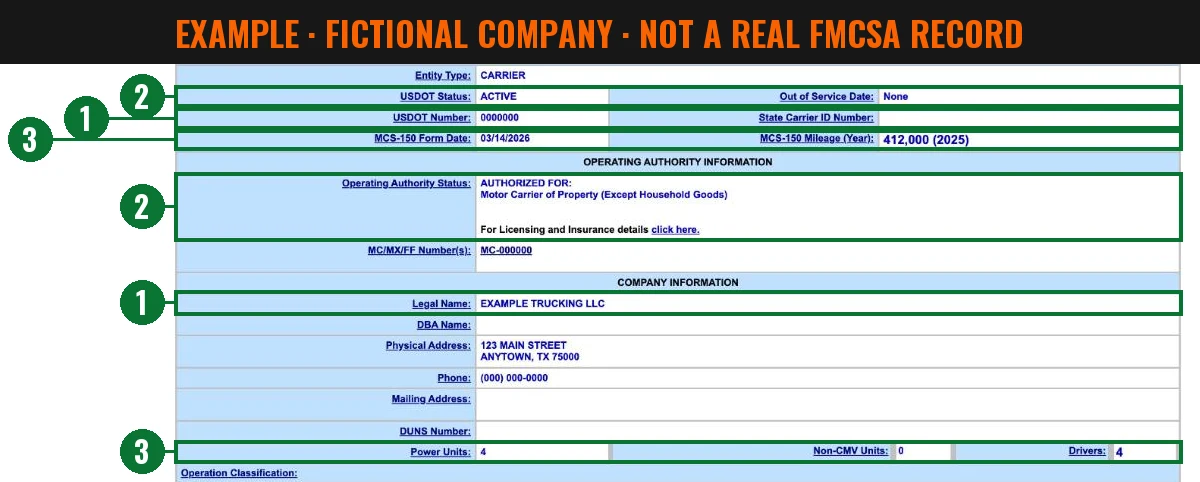
Check that the legal name, address, phone and email in SAFER and Motus match your company records. Look at the MCS-150 date, the mileage year and the truck count, and correct anything wrong through Motus. (FMCSA's current pause on biennial-update enforcement covers the every-two-years update, not changes like a sale.) A coverage gap or a revoked-then-reinstated authority won't always kill a sale, but you want to be the one explaining it.
Then check what the public record doesn't show. Factoring companies and lenders often file UCC-1 financing statements against carriers. Under UCC § 9-307(e), an LLC or corporation is "located" in the state where it was formed, so start the UCC search there; your attorney can tell you whether title liens or other searches are needed too. If you factored, get the payoff terms and a written release. A payoff quote alone doesn't prove the lien is gone.
Read your operating agreement or bylaws too. In Florida, for example, transferring an LLC interest doesn't by itself give the buyer the right to manage the company (Fla. Stat. § 605.0502). Becoming a member is a separate step under § 605.0401, for instance as the operating agreement provides or with the consent of all members. Other states have their own versions of these rules, so check your state's LLC act and your own exit as a member with your attorney.
Finally, the filings that keep a carrier legal: a BOC-3 on file (only a process agent can file it for a carrier), plus UCR, IFTA and IRP if the company has them. A missing IFTA quarter is easy to fix before a sale and painful after it.
The seller's paper stack
Gather this before you list:
- Your driver's license or other photo ID, matching the ownership documents and your authority to sign
- The EIN confirmation letter from the IRS (CP 575 or 147C)
- Articles of organization or incorporation, and proof the company is in good standing
- The operating agreement or bylaws, plus any membership or share records
- Loss runs from your insurer for the last two years, or for the company's whole life if it's younger
- IFTA returns, if the company has an IFTA account
- Filed tax returns for the company
- Any factoring agreement and its release, and any loan papers on company equipment
- A list of company-owned trucks and trailers with titles, if any are included
- Customer or broker contracts and any open claims or lawsuits
- A list of every account the company uses (FMCSA/Motus, load boards, ELD, bank, email, phone) and who controls each one
List accounts and who administers them, never passwords or one-time codes. The buyer's access gets set up through each provider's own process at closing.
Who controls the company's accounts
Since Motus launched in May 2026, FMCSA registration runs through personal, verified accounts. Each user profile is "unique to one person," sign-in goes through Login.gov, and the old USDOT PIN is gone. A company's main account holder invites other users and manages access.
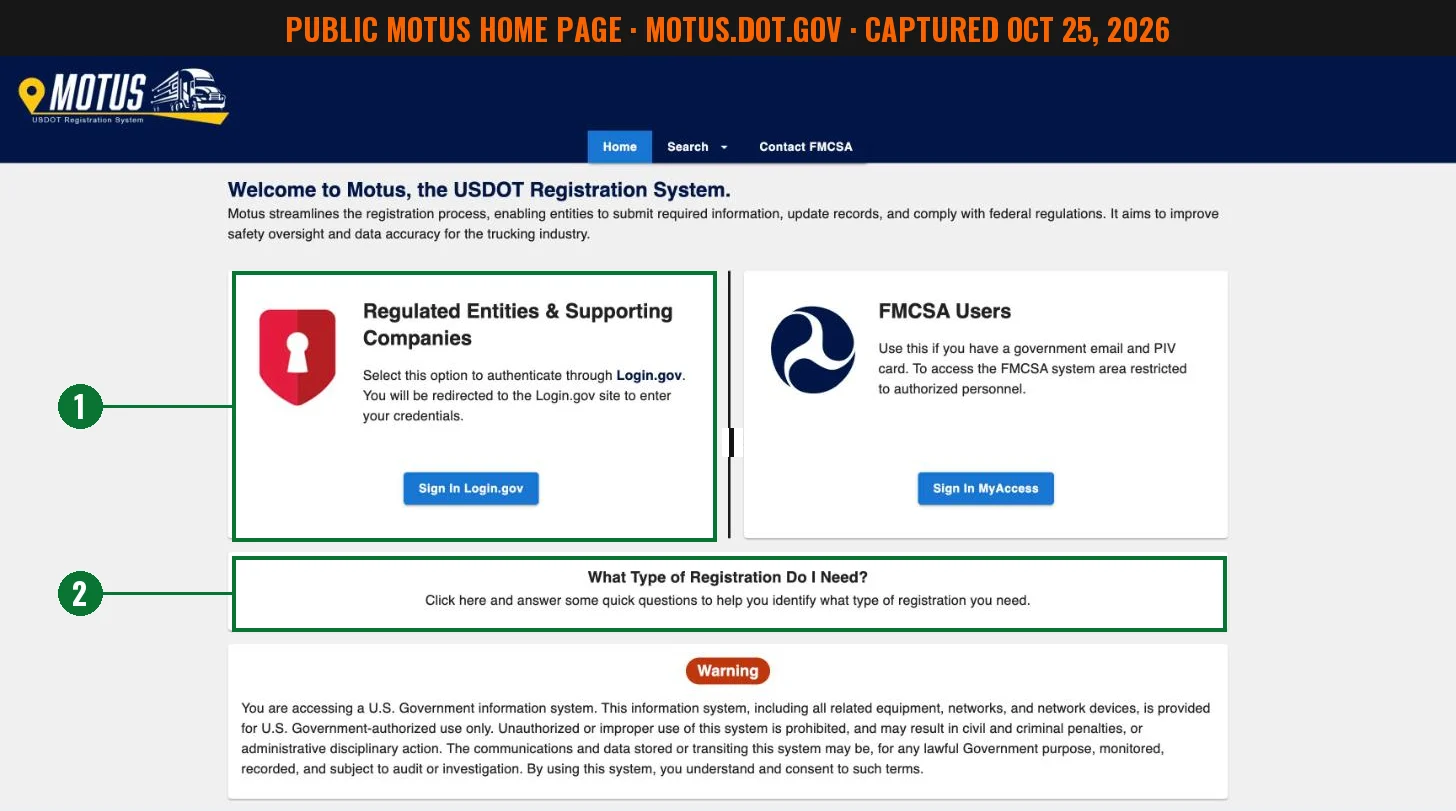
So you don't hand over your login. The buyer gets access through their own verified profile, and the company's contact details are updated to the people who will run it. FMCSA says some Motus changes need extra documents and agency review before they show up, so start early.
Back to that email address. Check the contact email on the company's FMCSA record and load-board profiles, separately from your personal Login.gov sign-in. If it belongs to a dispatcher, a filing service or anyone outside the company, put the change on the closing checklist, make it from your own signed-in account, and keep a screenshot. When a deal includes the company's email and phone, the contract should name the exact address and number being handed over.
Getting paid: why escrow
Be careful with a deposit sent before closing: it can be hard to recover if the sale falls through. In an escrow closing, a licensed escrow company holds the full purchase price before the seller hands over a single account.
For a seller that's the stronger position: instead of a slice of the price sent on trust, the whole amount sits with a neutral, licensed company, which confirms it's there. Escrow.com, for example, publishes its state licenses, and its NMLS ID (1370002) can be checked on NMLS Consumer Access. Under its general instructions, the money is released after the buyer accepts or the inspection period ends without a proper rejection; disputes follow the escrow company's own procedure.
Check the escrow company yourself, typing its address in by hand, and make sure it handles the sale of a company ownership interest. The agreement should say what you deliver and when the money is released. Hand over nothing until escrow confirms full funding.
Some sellers prefer a direct wire on closing day once the handover is confirmed. Whatever the method, it goes into the signed agreement before anything changes hands.
After closing: FMCSA, the IRS and your insurer
FMCSA
When an LLC or corporation keeps operating as the same company and only its owners or officers change, FMCSA's bulletin says that in many cases you only report that change; no transfer of authority is needed. Its FAQ says the USDOT number stays the same and an updated MCS-150 is due within 30 days. The bulletin says "immediately," so do it right away and keep the confirmation.
A transfer of authority to a different company is another matter. FMCSA ended its approval process for those transfers in 2013. Today it records a transfer when it's part of a purchase of an entire operation, both sides document it, and, per the bulletin, operations continue with the same safety management oversight and controls; otherwise new authority may be required. In 49 CFR Part 365, Subpart D, the 2015 reporting rules have been suspended since November 17, 2023, and older "T" versions are printed in their place. If your deal involves a new company, ask FMCSA (1-800-832-5660) and your attorney what to file. The buying guide shows the buyer's side.
Insurance
Your liability filing (BMC-91 or BMC-91X) is filed by the insurance company, not by you. If the buyer's insurer files a replacement that FMCSA accepts, your insurer's liability under its filing ends on the replacement's effective date (49 CFR 387.313T(e)). Without a replacement, a cancellation takes effect 30 days after FMCSA actually receives the BMC-35 notice (§ 387.313T(d)). Your policy, its cancellation and any premiums are a separate matter with your insurer. Plan the dates with your agent before closing so the company is never uncovered.
The IRS
Whether the company keeps its EIN depends on the entity and its tax setup, so have your accountant confirm it for this sale. If the company's "responsible party" changes, the IRS says to report it on Form 8822-B within 60 days. Your own taxes on the sale are a separate question for your CPA.
Your last day as the carrier
Set a written handover time for dispatch and the accounts, and decide who finishes loads in transit, collects open invoices and handles pre-closing claims. If you plan to keep driving for the company, agree your role, authorization and insurance with the new owners before you take another load.
Keep a closing file: the signed agreement, releases, payoff letters, the escrow statement or wire confirmation, FMCSA confirmations and records of the agreed access changes.
What stays with you
A sale moves the company, not every promise you made. A personal guarantee on a lease, a fuel card or a factoring agreement is your own obligation, and it can survive the sale unless the creditor releases you in writing. Ask each creditor what a release takes, and keep it; a buyer's promise to "take care of it" is not a release. Your warranties in the purchase agreement are yours too; ask your attorney which survive closing and for how long, and disclose everything you know.
An out-of-service order, open FMCSA case or unpaid penalty should be dealt with before listing; see Before you close your trucking company.
How TruckBiz works with sellers
TruckBiz USA is a marketplace for buying and selling whole U.S. trucking companies: LLCs and corporations, the full company with its MC and DOT attached. We don't trade numbers, and a sole proprietor's USDOT number can't be sold under FMCSA's rules.
You type your MC number and we build the listing from the company's federal record; you confirm it with a code sent to the phone or email on that record. On the board the listing is anonymous: no company name, MC number or contact details. A buyer sees them only after your manager opens the company to that buyer and the buyer signs an NDA and passes an ID check. Federal records are checked for listings, and flaws we find are shown. A manager calls you about the next steps. Every company on the board is sold by its owner: TruckBiz is the marketplace, not a party to the deal.
Start at truckbizusa.com/sell or call (888) 616-8249.
FAQ
Can I sell my MC number?
Not by itself; FMCSA warns against it outside a legitimate corporate transaction. If your MC belongs to an LLC or corporation, you can sell the company, and the MC and USDOT stay with it.
Do I need FMCSA approval to sell my company?
FMCSA ended its authority-transfer approval process in 2013, but reporting duties remain. If the same LLC or corporation keeps operating, its FAQ calls for an updated MCS-150 within 30 days of a change in company officials, and the bulletin says to update immediately. If a new company takes over the operation, confirm with FMCSA whether a transfer or new authority is needed.
How long does it take?
It depends mostly on your company records. Missing tax returns, an unreleased factoring agreement or an account in someone else's name cause most delays.
What happens to my trucks?
List every truck as included or excluded in the agreement. A company-owned truck you keep has to be properly moved out of the company before closing; personal or financed trucks need their own decision and, with a loan, the lender's say.
General information as of November 18, 2026, not legal, tax or insurance advice. Rules change, especially while Motus is new; check the sources below and talk to your own attorney and accountant. TruckBiz is not a law firm, insurer or escrow company and is not affiliated with FMCSA or Escrow.com.
Sources
- FMCSA, "DO NOT Sell, Purchase, or Lease a USDOT or MC Number" (bulletin, March 2026): https://www.fmcsa.dot.gov/newsroom/do-not-sell-purchase-or-lease-usdot-or-mc-number
- FMCSA FAQ, "How do I notify FMCSA of my Operating Authority (OA) ownership change?": https://www.fmcsa.dot.gov/faq/how-do-i-notify-fmcsa-my-operating-authority-oa-ownership-change
- FMCSA FAQ, "Do I need a new USDOT number if I am changing my company's Legal Name or Form of Business?": https://www.fmcsa.dot.gov/faq/do-i-need-new-usdot-number-if-i-am-changing-my-companys-legal-name-or-form-business
- FMCSA, Registration Modernization FAQs (Motus, Login.gov, USDOT PIN, changes that need review): https://www.fmcsa.dot.gov/registration/modernization-faqs
- FMCSA, "Move into Motus": https://www.fmcsa.dot.gov/registration/move-motus
- FMCSA, "Temporary Suspension of the Biennial Update Requirement": https://www.fmcsa.dot.gov/registration/temporary-suspension-biennial-update-requirement
- FMCSA, "Form BOC-3, Designation of Agents for Service of Process": https://www.fmcsa.dot.gov/registration/form-boc-3-designation-agents-service-process
- FMCSA FAQ, "What forms are required for insurance and where can I find them?": https://www.fmcsa.dot.gov/faq/what-forms-are-required-insurance-and-where-can-i-find-them
- 49 CFR Part 365, Subpart D (transfers of operating authority; effective-date notes): https://www.ecfr.gov/current/title-49/part-365
- 49 CFR 390.19T (Form MCS-150): https://www.ecfr.gov/current/title-49/section-390.19T
- 49 CFR 387.313T (insurance filings, cancellation notice, termination by replacement; § 387.313 itself is suspended): https://www.ecfr.gov/current/title-49/section-387.313T
- IRS, "When to get a new EIN": https://www.irs.gov/businesses/small-businesses-self-employed/when-to-get-a-new-ein
- IRS, "About Form 8822-B": https://www.irs.gov/forms-pubs/about-form-8822-b
- Florida Statutes § 605.0502 (transfer of transferable interest): http://www.leg.state.fl.us/statutes/index.cfm?App_mode=Display_Statute&URL=0600-0699/0605/Sections/0605.0502.html
- Florida Statutes § 605.0401 (becoming a member): http://www.leg.state.fl.us/statutes/index.cfm?App_mode=Display_Statute&URL=0600-0699/0605/Sections/0605.0401.html
- Uniform Commercial Code § 9-307 (location of debtor): https://www.law.cornell.edu/ucc/9/9-307
- Escrow.com, "Licenses and Complaints": https://www.escrow.com/escrow-licenses
- Escrow.com, "General Escrow Instructions": https://www.escrow.com/escrow-101/general-escrow-instructions